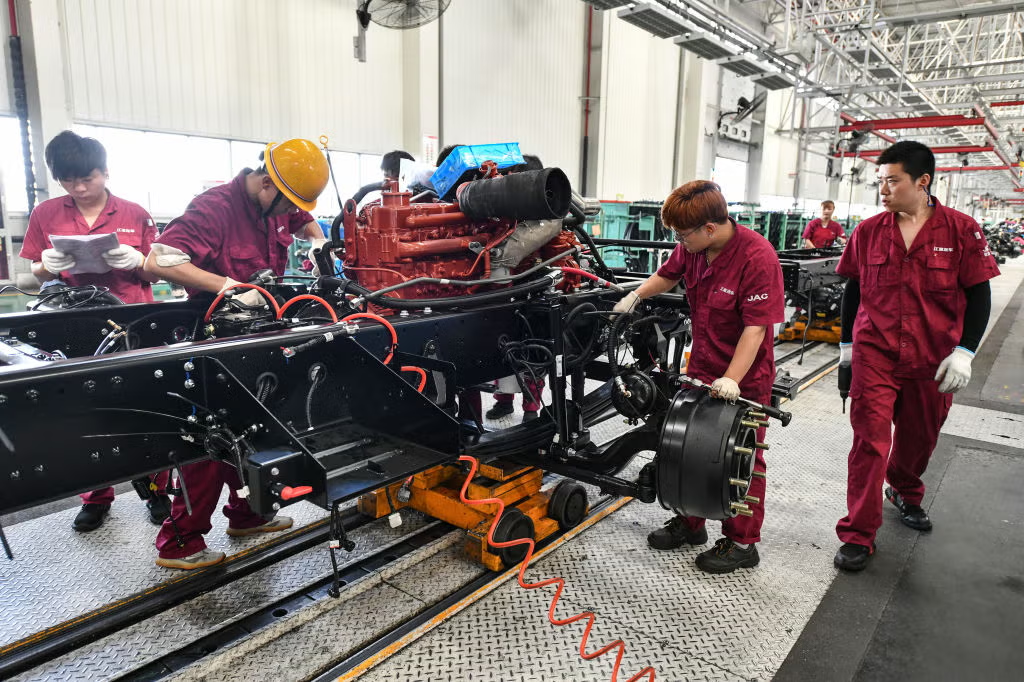

Globally, manufacturing has faced a challenging year in the wake of the Covid-19 pandemic. From supply chain breakdowns, workforce restrictions and unprecedented volatility in demand, manufacturing has indisputably been impacted. This has had a ripple effect across global value chains with some countries being more resilient to a manufacturing downturn than others.
Investment Monitor’s Manufacturing Vulnerability Index 2020 explores which countries are most vulnerable to a weakened manufacturing industry. The index considers employment, value added by manufacturing, number of exports, population and forecasted output growth. Using these metrics, the index examined the top 100 global foreign direct investment (FDI) locations and found that China, India, Myanmar, Egypt and the Philippines are the most vulnerable, respectively.
Europe and Asia the most vulnerable regions
Notably, four of the top five most vulnerable countries are within the Asia-Pacific region. However, overall, the index shows Europe to be the most vulnerable region, followed closely by Asia-Pacific.
Figures from GlobalData used in the index also show significant changes in the proportion of employment in manufacturing within the top 20 countries between 2009 and 2019. It should be noted that ‘secondary sector’ translates to industrial sectors so can include the likes of oil production, construction and mining alongside manufacturing.
This chart shows that the gap between the top two countries for employment proportions in manufacturing has been substantially closing since 2019, with Oman rapidly increasing its percentage of industrial workforce and the Czech Republic declining. Both Sri Lanka and Cambodia have also seen vast increases in their industrial workforces, whereas Bulgaria’s has dropped significantly.
Of course, the Covid-19 pandemic is set to have an immediate impact on not only these workforces but overall manufacturing output. Russia, Brazil and South Africa are set to see their forecasted manufacturing output decrease the most in 2020 at -25.1%, -23.8% and -23.6%, respectively.
China’s manufacturing over-reliance
The index shows that overall China is the most vulnerable country to a manufacturing downturn. Known as ‘the world’s factory’, China has established itself as a manufacturing powerhouse over the past few decades. In 2018 alone, manufactured goods from China made up 94% of its total merchandise exports.
A combination of low-cost workers, a well-integrated ecosystem of suppliers, manufacturers and distributors, liberal regulations and competitive product costs have all been key to China’s manufacturing success story. However, the Manufacturing Vulnerability Index shows just how reliant China is on the success, value and demand of its manufacturing sector.
China has reported some successes amid the Covid-19 pandemic. The data used in the analysis (including figures sourced from IMF’s World Economic Outlook database as of April 2020) showed that the country is forecasted to see a 1–2% increase in GDP in 2020. This comes alongside reports that China’s economy is experiencing a V-shaped recovery from the impact of Covid-19, in contrast to the U-shaped recovery being predicted for most developed economies. However, the sustainability of this recovery has been called into question, as it relies more on investment than consumption.
What is for certain, however, is that the continued success of China’s manufacturing sector will be required to sustain any recovery. The Chinese government appears to be aware of this and is pushing for heightened investment across the infrastructure and manufacturing sectors. It should be noted that this agenda to invest in a more robust manufacturing sector is likely spurred by the rising tensions between China and the US.
China has created a $21bn national investment fund intended to strengthen and rejuvenate the country’s manufacturing industry. Alongside this, the index shows that the manufacturing value added has increased in China at an average annual rate of 13.6% between 2000 and 2019. The is one of the highest rates of all the countries analysed, and shows how important the success of the manufacturing industry has been in China over the past two decades, not to mention its importance to the country’s future.
Furthermore, our figures show that China’s manufacturing output in 2020 is set to grow by 1.4%. Out of 60 countries included in the figures, China was one of only four set to see growth despite the impact of Covid-19.
India stilted by Covid-19
India is the second most vulnerable country within the index, and its manufacturing value added between 2010 and 2019 increased by an average annual rate of 6.84%, according to data from the UN Industrial Development Organisation. Following the pandemic, India’s manufacturing industry is set for a stark decline, with GlobalData estimating a 17.7% drop in output in 2020.
Before Covid-19 hit, the country seemed set to strengthen its popularity among investors in line with the rising China de-risking trend. In moves to transform its industry and minimise reliance on Chinese imports, India was investing in its own raw material supply chains. Before the pandemic, the India Manufacturing Barometer 2019 report from PwC stated that experts were forecasting a 35% decrease in imports to India between 2019 and 2024.
Many will be watching to see how the country recovers these strategies while taking advantage of new opportunities that the pandemic may afford it. With companies now looking to dilute their supply chain risk, India could position itself as an alternative to China.
The manufacturing industry has been transformed over the course of 2020, with many greenfield investors re-evaluating the success of their supply chains. It has also shone a light on manufacturers that have been too slow to embrace the necessary advantages industry 4.0 can afford factories. As the dust settles following the hit from Covid-19, these vulnerable countries will need to embrace advanced manufacturing practices in order to ensure the future prosperity of their industries.